
Commercial banks in the country continued with their improving asset quality trend in the October-December 2021 quarter with slippages remaining under control coupled with healthy recoveries and upgradation of asset classification. The 28-listed banks reported improvement in bottom line with net profits rising 64.1 per cent year-on-year (YoY) and 21.5 per cent sequentially. This is mostly on account of a fall in provisions and contingencies.

Typically, about four to six weeks ahead of the polls, activity in the property market picks up as politicians begin to pull out their money parked in real estate. But this time, it's all quiet till now in real estate so far.

The latest circular from BSE that sought to cap the price movement of select scrips, especially the mid-, small-cap segments, traded on the exchange is not without a reason. A quick calendar year-to-date price check on the stocks from the categories put under 'Add-on Price Band Framework' by the BSE reveals a total of 210 stocks have seen their market price more than double. Among individual stocks, SC Agrotech, Adinath Textiles, Waaree Renewable Technologies, Steel Strips Infrastructure, Unistar Multimedia, Texel Industries, Raja Bahadur International and Hindustan Everest Tools from the BSE's X and XT group have rallied over 500 per cent during this period. Topping the charts is Gita Renewable Energy, which has zoomed 3,964 per cent to Rs 272.35 now from Rs 6.7 as on December 31, 2020.

The coming years could be exciting for Bandhan Bank, IDBI Bank, IDFC First Bank, Federal Bank, and CSB Bank.

A weak economy coupled with rising Covid-19 cases and inflation that is above RBI's comfort zone, geopolitical developments, and upcoming India Inc's second quarter results for FY21 could impact sentiment, analysts say.

Indians face COVID-19 with record debt, stalled income.
With a 'yes' vote, there is a more foreseeable outcome, while a 'no' could result in greater uncertainty, for which retail investors may not have the appetite.

Coal India Ltd's Rs 15,000 crore (Rs 150 billion) mega issue, which opens on Monday for public subscription, has garnered a bullish endorsement from most of the market experts who believe it would be the star attraction of this week for all, including retail investors.

Sanjiv Mehta, chairman of the country's largest consumer goods company, HUL, believes that the second wave of the Covid-19 pandemic between April and June this year has been a mere pause in India's consumption story, and that it will not change the country's overall growth trajectory. India is poised for growth, especially in the fast-moving consumer goods (FMCG) sector, Mehta told shareholders at the company's annual general meeting on Tuesday. The signs of recovery are becoming evident with many states lifting lockdown restrictions in recent weeks.

Equity mutual funds witnessed an outflow of Rs 9,253 crore in January, making it the seventh consecutive monthly withdrawal, primarily due to profit booking and portfolio rebalancing amid markets touching new highs. The pace of outflows from equities has however slowed for the third month and Gautam Kalia, head - Investment Solutions, Sharekhan by BNP Paribas said that it will likely turn positive soon as investors get used to the new normal. In addition, investors pulled out Rs 33,409 crore from debt mutual funds last month after investing Rs 13,863 crore in December, data from the Association of Mutual Funds in India showed on Tuesday.

At the BSE, 1,879 companies declined, while 685 advanced and 131 remained unchanged.

Many investors, who have made money in the rising market of the recent past, are pulling out of equity funds, believing that they can earn more by investing directly.

TCS was the top gainer in the Sensex pack, rising over 3 per cent, followed by L&T, Bharti AIrtel, HCL Tech, Tata Steel, Bajaj Auto and Reliance Industries. NSE Nifty rallied 164.70 points to its fresh closing peak of 16,529.10.

If international crude oil prices zoom past the current level of about $90 per barrel and move towards $100 and beyond, middle-class consumers are not going to keep quiet about their discomfort, points out Arun Balakrishnan, former chairman and managing director, Hindustan Petroleum.

As if wanting to be an antidote to the coronavirus pandemic, the Indian stock market adorned carnival robes in 2021 with a tsunami of liquidity unleashed by global central banks coupled with supportive domestic policies and the world's largest vaccination drive sparking off a world-beating rally on Dalal Street, despite bouts of uneasiness over fizzy valuations. While the wider economy shuttled between recovery and relapse, dictated by multiple mutations of the virus, equity market benchmarks appeared headed in just one direction -- skywards. The dizzying upward journey has added a whopping Rs 72 lakh crore during 2021 to investors' wealth, measured as the cumulative value of all listed shares in the country, taking it to nearly Rs 260 lakh crore.

After a very weak December quarter and a poor year-to-date fiscal year volumes-when sales plunged to the lowest in nine years, the signs in the first 15 days of January haven't been encouraging either. "Though the severity of the current wave is not as high as the previous one, it has hit the sentiments hard impacting conversion of enquiries into sales," said Vinkesh Gulati, president, Federation of Automobile Dealers Association (FADA).

Dr Reddy's Laboratories on Friday soft-launched imported COVID-19 vaccine Sputnik V, with Deepak Sapra, a senior executive of the drug-maker, taking the first shot in Hyderabad.

Operational income not covering even their interest expenses, finds study; analysts say if economy turns around, new equity issuances an option
The stock market continuously throws up opportunities.

The relentless rally in small- and mid-cap stocks continues as large-caps show signs of fatigue. In July, the Nifty Smallcap 100 rose 8.1 per cent, extending its year-to-date (YTD) gains to 48.5 per cent, while the Nifty Midcap 100 added 3.1 per cent, taking its YTD rise to 33.5 per cent. On the other hand, the Nifty50 remained unchanged for the month, with YTD gains of 12.7 per cent.

'For the next two years, we expect the bulk of earnings growth contribution from sectors like financials and energy, where the outlook remains positive, while the sectors which are linked to domestic consumption and are currently witnessing strains on margins have low salience for Nifty earnings.'

Through the IPO, Burger King has raised Rs 450 crore, which will be used to rollout new outlets and retire debt.

The Reserve Bank's rate-setting panel began its three-day deliberations on Monday to decide the next monetary policy amid expectations that the central bank will maintain status quo on the benchmark interest rate in the backdrop of global scare due to the new coronavirus variant Omicron. Reserve Bank Governor Shaktikanta Das headed six-member Monetary Policy Committee (MPC) is scheduled to announce the policy resolution on Wednesday. If the RBI maintains status quo in policy rates on Wednesday, it would be the ninth consecutive time since the rate remains unchanged.

Second-tier NBFC stocks are trading at 24.4x their trailing earnings, which is nearly twice their 15-year average of 13.9x
In terms of stock selection, India continues to benefit from two phenomena - the big getting bigger and availability of quality stocks in relative abundance compared with its Asian peers.

Indian phone company Lava reveals a new strategy, reports Arnab Dutta.

In the mid-tier space, clients with weak balance sheets are likely to ask for price revision apart from delay in payment.

Scanty rainfall, last year's lockdown, growing competition from Nepal and the disaster of the 2017 Gorkhaland agitation are steadily weakening exports and sales of Darjeeling tea.

'Investors should plan and make investments strictly on the basis of their risk profile.' 'They should not bite more than they can chew.'

Tata Steel was the top loser in the Sensex pack, sinking over 5 per cent, followed by SBI, IndusInd Bank, Bajaj Finance, HDFC Bank and NTPC. NSE Nifty tanked 371 points to 16,614.20.

Auto companies are now grappling with a slowdown in sales, triggered by pent up demand due to the COVID-led lockdown easing a bit and supply-side issues for raw material.

Banks have swung into action as gold prices continue to slide. Reduced loan-to-value ratio (LTV), cautious lending, and a close monitoring of the gold loan portfolio have prompted them to hedge their loan books against the reduction in prices.
the broader NSE Nifty settled 114.90 points, or 0.96 per cent, higher at 12,086.70. Axis Bank was the top gainer in the Sensex pack, rallying 4.21 per cent, followed by Vedanta 3.75 per cent, SBI 3.39 per cent, Maruti 3.20 per cent, IndusInd Bank 3.07 per cent and Yes Bank 2.87 per cent. Bharti Airtel slipped 1.98 per cent, Kotak Bank 1.38 per cent, Bajaj Auto 0.88 per cent, Asian Paints 0.31 per cent, HDFC Bank 0.05 per cent and HUL 0.03 per cent.
The liquidity-fuelled rally will continue for some time, however, fundamentals are getting stretched.

Analysts caution a non-BJP government is not an impossible scenario. In case of a Modi-led coalition, they advise investors to focus on discretionary consumption, select private banks and financials, RIL, housing, and IT.

Samsung is lining up new products, increasing focus on e-commerce channels and tightening its grip over retail outlets.

Auto-debit payment bounces have gone up for the second consecutive month in May, emphasising the stress building up due to a halt in economic activities as authorities lock down various parts of the country to stop the spread of the virus in the second wave. According to the National Automated Clearing House (NACH) data, in May, of the 85.7 million transactions initiated, 35.91 per cent, or 30.8 million transactions, failed.
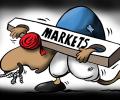
Axis Bank was the top loser in the Sensex pack, shedding over 4 per cent, followed by Asian Paints, SBI, IndusInd Bank, ICICI Bank, Bajaj Finance, HDFC and Reliance. On the other hand, Bajaj Auto, Hindustan Unilever, UltraTech Cement, TCS, Bajaj Finserv and Infosys were the gainers.

At the end of 2018-19, the Tata group had a consolidated debt of Rs 2.77 trillion. Tatas not only plan to avoid big-ticket acquisitions for now, the group's main focus will be on improving key metrics and reduce debt, say Shally Seth Mohile & Dev Chatterjee.
 © 2026 Rediff.com - Advertise with us - Disclaimer - Privacy Policy - Sitemap - Feedback - About us - Terms of use - Grievances